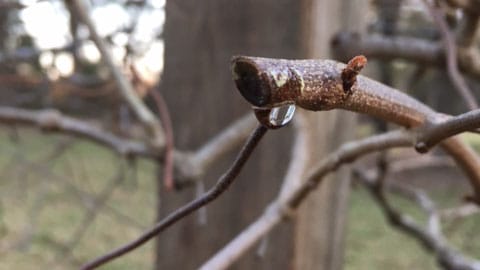
Following a late winter or early spring pruning of Maple, Birch, Elm, or Grapevines it is common to observe “bleeding” from the pruning wounds. This phenomenon usually occurs just before and during leaf emergence in the spring, especially during years of abundant soil moisture. The temporary bleeding is generally not detrimental to the health of the plant and primarily consists of a watery sap solution. The bleeding usually ceases once the leaves have fully emerged and water begins to evaporate through the leaf stomata, creating transpirational pull that overshadows the root pressure.
The upward flow of water is caused by osmotic pressure in the root system that begins with the imbalance of water molecules between the soil and the root system. A high concentration of minerals and carbohydrates in the root system generally translates to a lower concentration of water molecules when compared to the surrounding soil. Water molecules enter the root cells to equalize distribution, causing root cells to become turgid and force water upwards in the vascular system. (Incidentally, the reverse is true when too much fertilizer is applied and a higher concentration of minerals in the soil prevents the osmotic absorption of water into the root system.)
Occasionally, bleeding can be a nuisance where these plants drip on parked cars and pedestrian spaces. In such cases, delay pruning of these species until late spring-early summer to help to reduce the issue.
If prolonged bleeding occurs and you observe any unusual signs or symptoms of pests or disease, report the information to your local extension agent for further assessment.
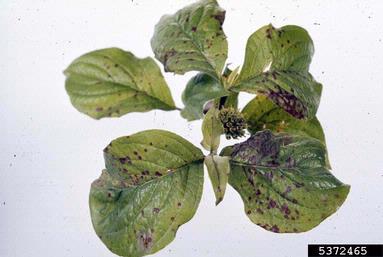
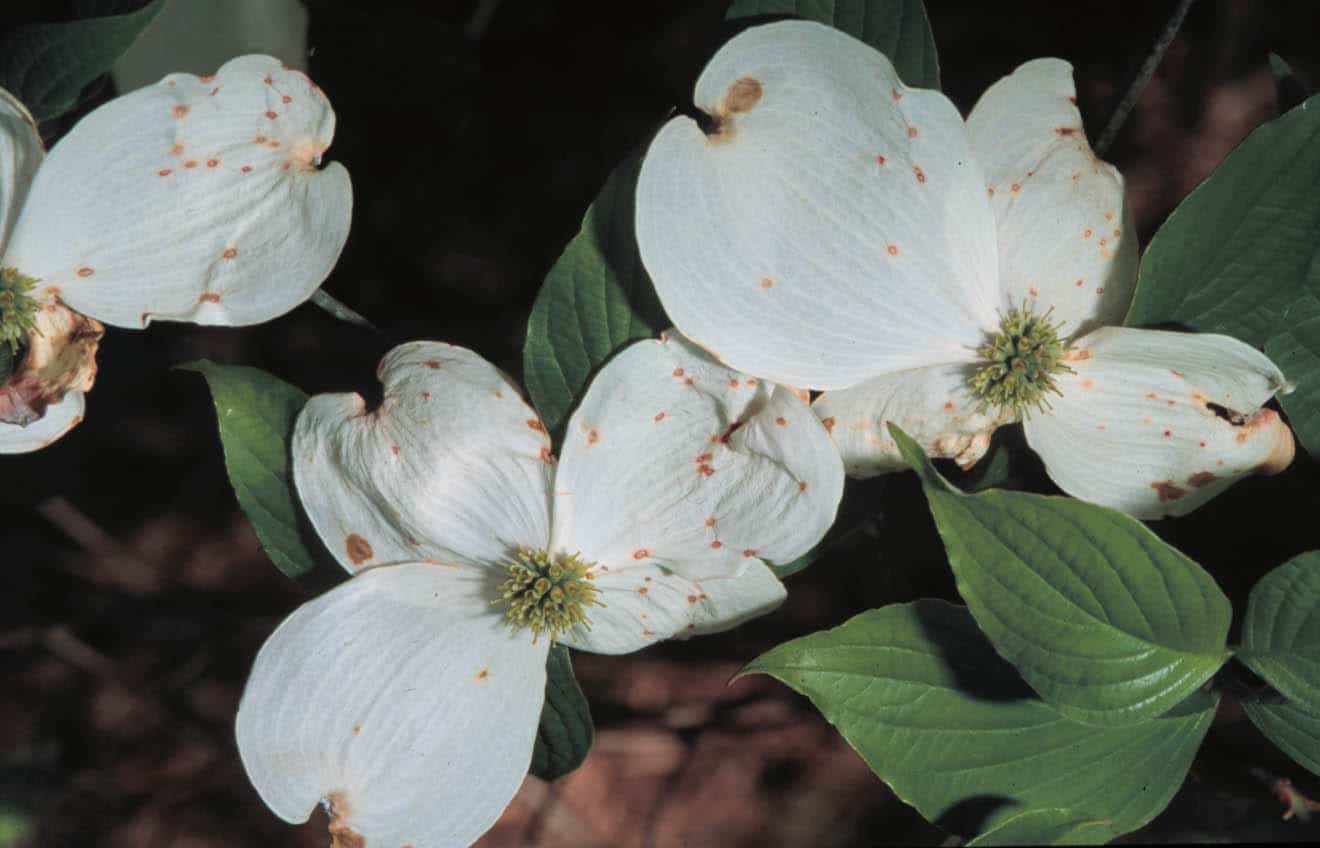
Small, reddish spots first appear on flower bracts. Reddish spots appear on leaves; leaves become distorted from infection in bud stage. Disease may cause leaves to drop.
Disease Management:
Rake and remove fallen leaves.
Disease will not cause significant damage to the tree.
Fungicides applied at swollen bud stage for flowers and leaves can reduce infection, but are only recommended for young, newly-transplanted trees.
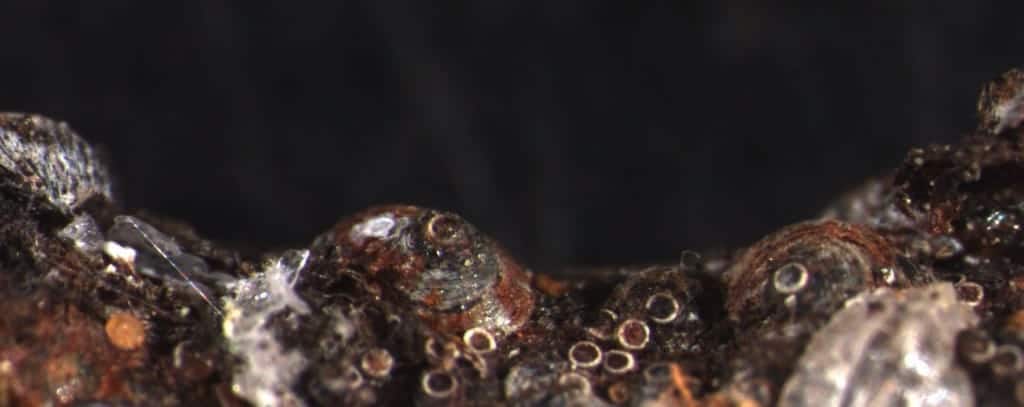
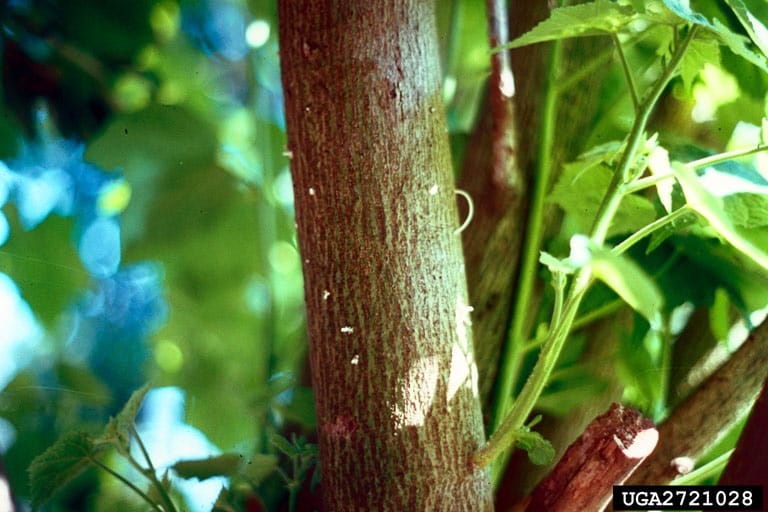
Gloomy scale, Melanaspis tenebricosa, is an armored scale that feeds on maples and other tree species. It becomes very abundant on red maples on streets and in landscapes and can cause branch dieback and tree death in some cases. It is not unusual to find trees with nearly 100% of their trunk covered in scale. Street trees are particularly prone to gloomy scale. Crawlers of this scale are active now and can be seen on bark and under scale covers. One of the reasons we have found this to be such a pest is that female gloomy scales produce about 3 times as many eggs when they live on relatively warm trees (like in a parking lot) than when they live on cooler trees (like in a shady yard). This amazing work is outlined in a recent paper by Adam Dale.
Control of this scale is complicated because crawlers emerge over 6-8 weeks so it is impossible to treat all the crawlers at once with horticultural oil or other contact insecticide. This is different than in other scales, such as euonymus scale, in which all crawlers are produced within a narrow window of 2 weeks or so. Adam Dale took a video of some gloomy scale crawlers so you can get an idea of how tiny and nondescript they are. This may also give you an idea of why scales are so vulnerable at this stage to the environment, predators, and insecticides like horticultural oil. Once they produce their thick waxy cover they are much less vulnerable to all these factors.
Disease Symptoms:
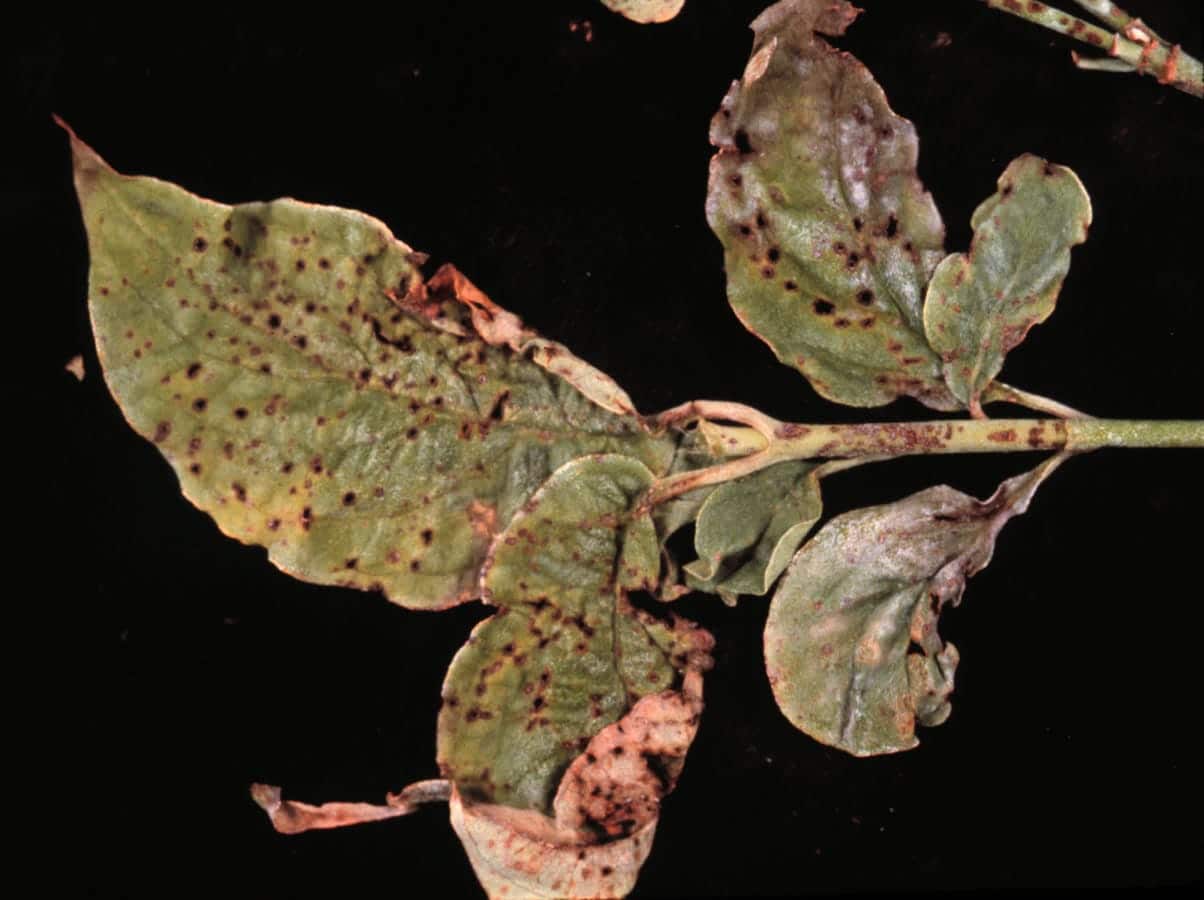
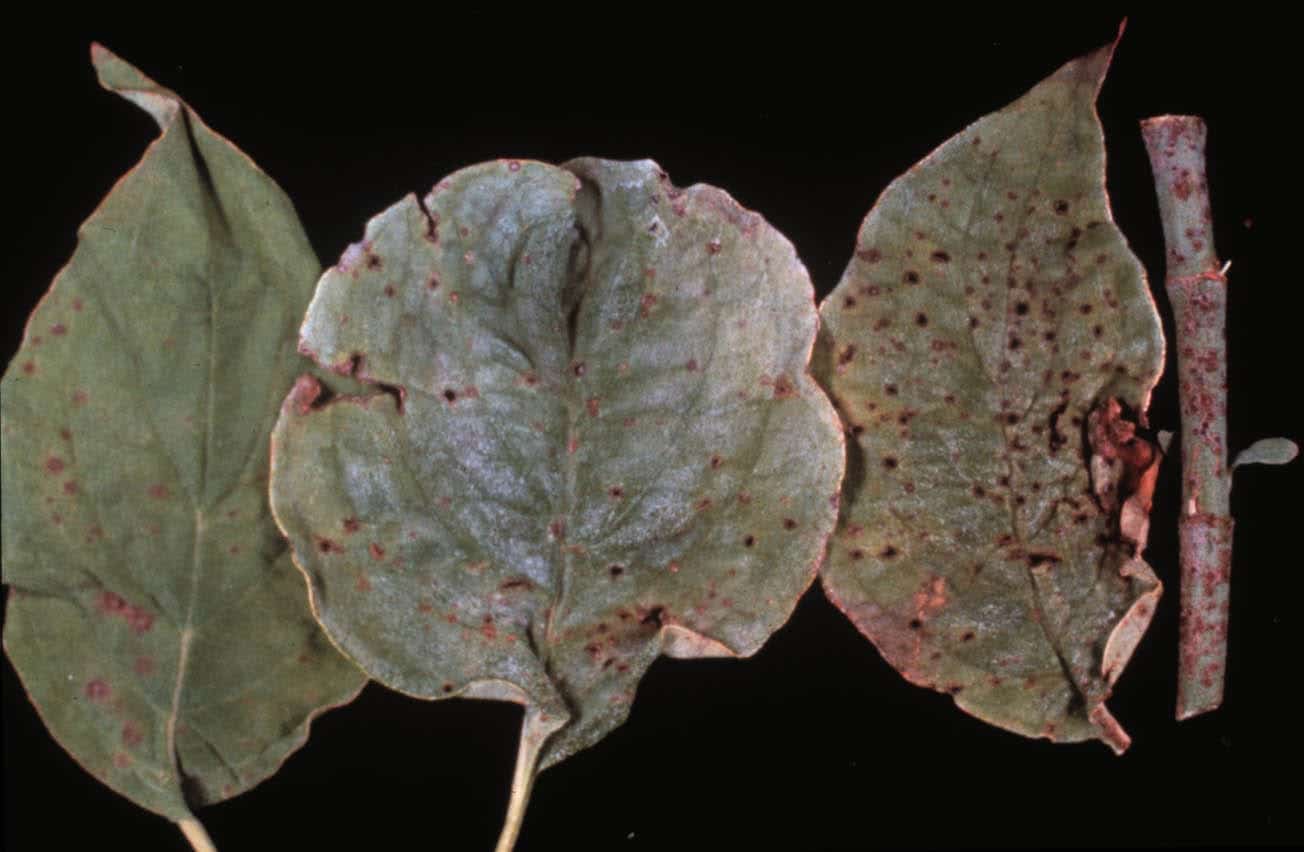
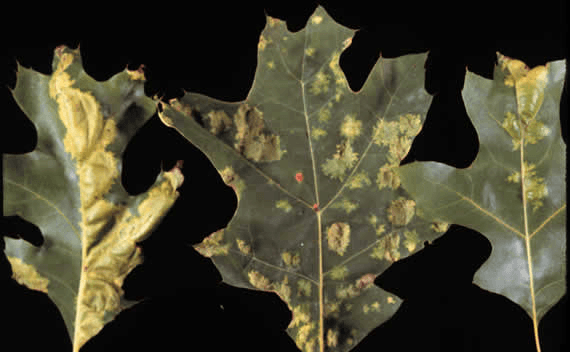
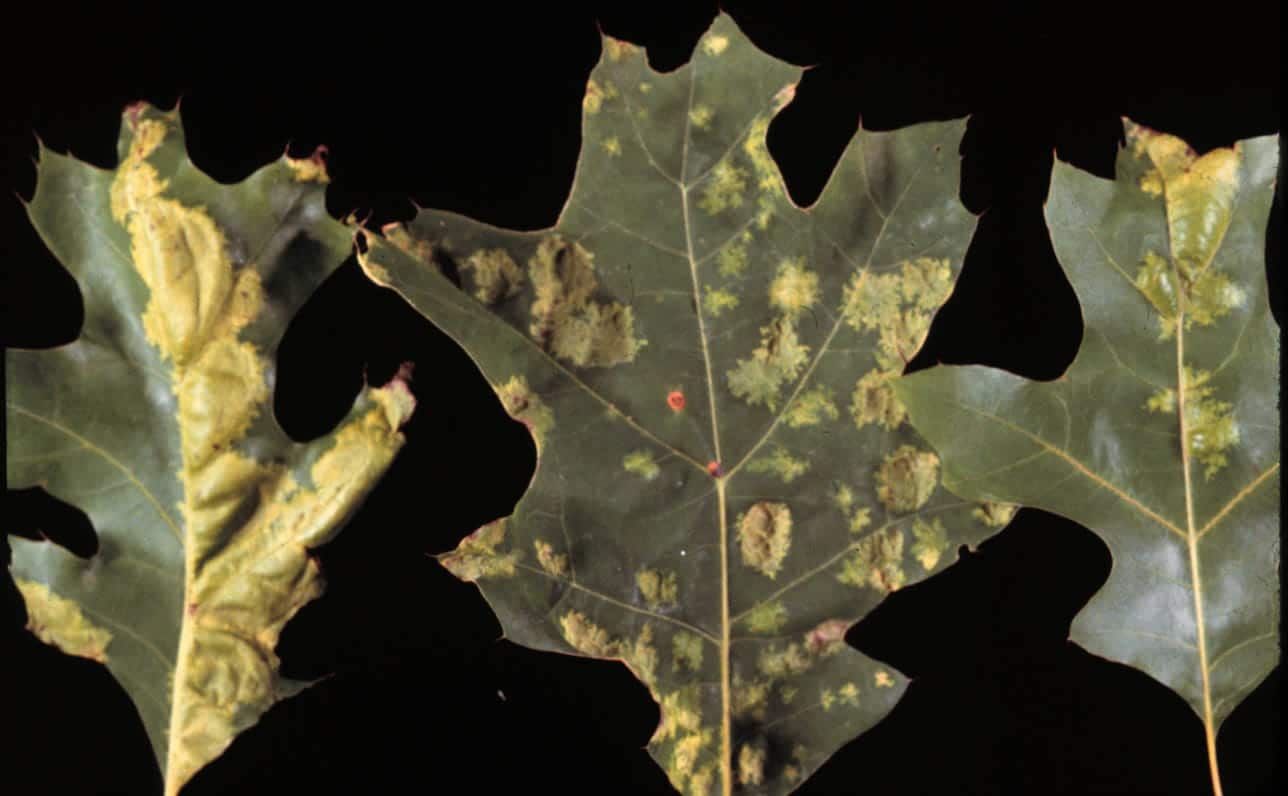
Bulging, blister-like spots on leaves, may cause leaf distortion. Underside of leaf turns brown following spore production. Can be confused with eriophyid mite or midge damage. Affected leaves drop prematurely.
Disease Management:
Disease seldom causes significant damage. Apply fungicide spray when leaf buds swell in the spring and reapply at 7-10 day intervals until the leaf fully expands to reduce disease.
Info taken from the publication Control of Common Pests of Landscape Plants by Tim Daly, Gwinnett County Cooperative Extension Agent and Beverly Sparks & Will Hudson, Extension Entomologists.
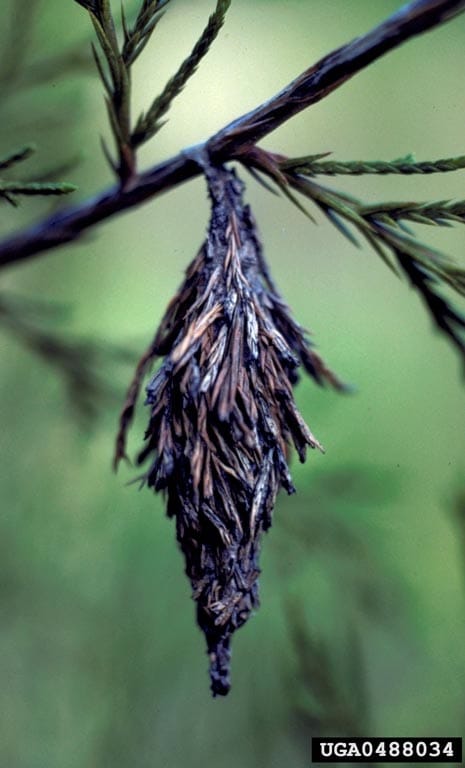
Bagworms construct and live inside a 1- to 2-inch long tough, tear-shaped portable silken case. These bags are the insect’s most easily seen and identifiable feature. Outside, the silken texture of the bag is somewhat concealed with layers of leaf, twig and bark fragments. The bag has an opening at the larger end that allows the worm to partially crawl out to make repairs to its bag and eat.
Bagworms attack broadleaf and coniferous trees and shrubs. Here are some control measures.
Follow proper watering, fertilizing and pruning practices.
Remove other stress factors from trees when possible.
Infested plant material cannot be treated and should be removed and disposed of.
Protect trees from infestation or reinfestation by using products containing bifenthrin or permethrin. Make first application in April and subsequent applications in late May, mid-July and late August.
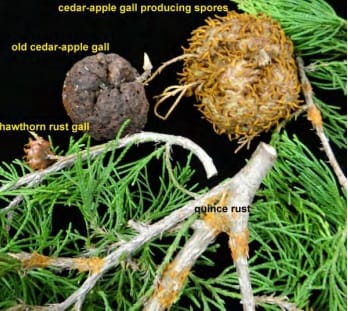
Each spring, as the leaves of Rosaceous plants such as apple, pear, and hawthorn are emerging, the Eastern Red Cedar (Juniperus virginiana) produces the bright orange fructifications of a group of rust fungi in the genus Gymnosporangium. Early spring rains induce the cedar rust galls to break hibernation and produce gelatinous orange protrusions that release basidiospores. However, these basidiospores do not re-infect the cedar tree but instead drift off to find the appropriate secondary Rosaceous host (like apple, pear, and hawthorn). On the leaves and/or fruit of the secondary host, the fungus will mate and produce a different type of brightly colored spores. These spores only infect the cedar tree and this infection results in the cedar galls that can take up to two years to mature.
Image 1 – Cedar apple rust (top of image), hawthorn rust and quince rust
The most common and visible cedar rust is cedar-apple rust (G. juniperi-virginianae). Cedar-apple rust forms large round galls on the small branches of the cedar trees. (see image 1) The basidiospores produced by the galls infect the newly emerging leaves of apple and crabapple. On susceptible cultivars, the resulting leaf lesions can cause the leaves to fall during years of heavy infection. Fungicide sprays may help on susceptible trees. However, in the home and/or organic garden, the use of apple cultivars with resistance to both cedar apple rust and fireblight is highly recommended. Removal of cedar trees in the immediate area can help but may not be practical. Check the Georgia Homeowner’s Pest Management Guide for recommended treatments and cultivars.
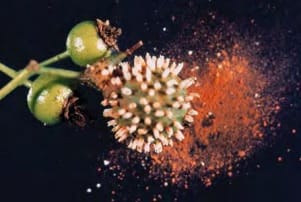
Two other cedar rusts are common in Georgia, quince rust (G. clavipes) and hawthorn rust (G. globosum). The perennial galls of quince rust are formed under the bark on the cedar branches and are nearly invisible until the gelatinous protrusions emerge from cracks in the bark (see image 1). The spores produced by these galls infect the fruits of the apple, quince, mayhaw, and pear (see image 2). Hawthorn rust produces small inconspicuous galls on the cedar (see image 1). This rust infects the leaves and shoots of ornamental hawthorn.
Asian or granulate ambrosia beetles are tiny (<1/8″) wood-boring insects that attack the trunks of young and weakened trees and shrubs. Ambrosia beetles tunnel into stems and construct galleries where they raise their young. Beetles carry on their bodies a fungus that grows in these galleries producing ambrosia which feeds both adults and larvae. Ambrosia beetles can also carry the spores of disease pathogens that infect the tree. The growth of these fungi can lead to weakening or death of the tree.
As ambrosia beetles tunnel, they push sawdust out through their entry hole. This sawdust can cling together forming short ‘toothpicks’ sticking from the infested stem. These toothpicks make it easy to identify ambrosia beetle attacks.
Wind or rain may destroy these toothpicks leaving just the small holes and scattered sawdust from the beetle. Since the entry holes are only about the size of a #2 pencil lead, close inspection is necessary to detect these attacks in time to treat. Ambrosia beetles attack many types of trees and shrubs including crape myrtles, cherries, oaks, sweet gums, pecans, peaches and others.
The ambrosia beetle’s first flight occurs with mild weather typically in February but possibly as early as January. Cold weather will put them off for a while, but we usually see a big emergence of the granulate ambrosia beetle ranging from February in south Georgia to early March in north Georgia.
Young trees in nurseries and trees that have been in landscapes for less than three years old are vulnerable to attack even if they are not obviously stressed. This is especially true during the green-up period. Prompt action can save these trees if the number of attacks (“toothpicks”) is less than 4 – 5 per tree.
Growers of nursery trees and shrubs, as well as landscapers with new trees, can apply a spray to protect vulnerable trees. The spray should be repeated every 10 – 14 days until the plants are completely leafed out.
If applied in time, pyrethroid insecticides can repel the beetles even after plants are attacked. Pyrethroids like permethrin (Pounce, Astro), Talstar, Decathlon, or others will work. Once the trees have leafed out completely, they are less attractive to the beetles unless the trees are under stress. Prevent stress to shrubs and trees to lower chance of ambrosia beetle injury.
Spray affected trees, being careful to cover the trunk completely. Monitor the trees for signs of wilting of the new leaves, a sign that a pathogen has been introduced. Once the wilting starts, the tree will probably die. Do not assume the attack will be fatal, since trees may recover. Also watch treated trees to see if new toothpicks develop – a sign that the ambrosia beetles are still active.
Nursery trees that are attacked should be sprayed and separated from the rest of the block (if possible), and watched closely for signs of wilting. Nursery trees that are attacked but don’t wilt may not need to be destroyed. If they leaf out and seem healthy and no further toothpick formation is noted, then the small holes will heal quickly and leave no permanent damage.
If you see toothpicks on larger trees, the tree is probably severely stressed. If attacks are confined to one limb, pruning is an option. If the attacks are on the main stem, prepare to remove the tree if it dies.
Considering the history of this pest in Georgia, there is a good chance that any given nursery or landscape will suffer little or no damage and spraying will not be necessary. Watch susceptible trees or shrubs closely for beetle attacks.
Traps can be used to monitor the activity of this pest. For more information on constructing Ambrosia beetle traps see Activity Monitoring in this publication.
Because flowering ornamentals form their flower buds at different times of year, pruning times must be adjusted accordingly. Many spring-flowering plants such as azalea, dogwood, forsythia, redbud and rhododendron set flower buds in the fall, so pruning during the fall or winter months eliminates or decreases their spring flower display. Plants that typically flower during the summer form flower buds on new growth and can be pruned during the winter with no effect on their flowering. Examples of this type of plant are crape myrtle and abelia.
As a general rule, plants that flower before May should be pruned after they bloom, while those that flower after May are considered summer-flowering and can be pruned just prior to spring growth. One exception to this rule is the oakleaf hydrangea, a summer-flowering shrub that forms flower buds the previous season. Another exception is late-flowering azalea cultivars, which bloom during May, June or even July. Prune both the oakleaf hydrangea and the azalea cultivars after they bloom. Table 1 provides suggested pruning times for other plants.
Table 1.Suggested Pruning Time for Common Flowering Trees, Shrubs and Vines
Prune after Flowering
Azalea
Japanese Pieris
Beautybush
Lilac
Bigleaf hydrangea
Mockorange
Bradford Pear
Oakleaf hydrangea
Bridalwreath Spirea
Pearlbush
Clematis
Pyracantha
Climbing roses
Redbud
Crabapple
Saucer Magnolia
Deutzia
Star Magnolia
Dogwood
Shrub Honeysuckle
Doublefile Vibernum
Thunberg Spirea
Flowering Almond
Vanhoutte Spirea
Flowering Cherry
Weigelia
Flowering Quince
Winter Daphne
Forsythia
Wisteria
Japanese Kerria
Witchhazel
Prune before Spring Growth Begins
Beautyberry
Goldenrain Tree
Camellia
Japanese Barberry
Chaste Tree (Vitex)
Japanese Spirea
Cranberrybush Viburnum
Mimosa
Crape myrtle
Nandina
Floribunda roses
Rose-of-Sharon (Althea)
Frangrant Tea Olive
Sourwood
Grandiflora roses
Anthony Waterer Spirea
Glossy Abelia
Sweetshrub
Hedges
Ornamental plants that are not grown for their showy flowers can be pruned during the late winter, spring or summer months. Avoid pruning during the fall or early winter because it may encourage tender new growth that is not sufficiently hardened to resist the winter cold.
Some shade and flowering trees tend to bleed or excrete large amounts of sap from pruning wounds. Among these trees are maple, birch, dogwood, beech, elm, willow, flowering plum and flowering cherry. Sap excreted from the tree is not harmful, but it is unsightly. To minimize bleeding, prune these trees after the leaves have matured. Leaves use plant sap when they expand, and the tree excretes less sap from the wound.
Pruning deciduous trees (trees that lose their leaves in the winter)
Trees are like children; training at an early age will influence how they develop. Many people are reluctant to prune a young tree, particularly when it is nothing more than a single stem or a few scrawny branches, but this is precisely when pruning should begin.
Ideally, deciduous shade trees (those that lose their leaves during the winter) and flowering trees should have one central trunk (leader) and five to eight strong lateral branches along the main trunk. Major limbs should begin about 5 feet above the ground and have good spacing around the main trunk.
Once the framework (trunk and main branches) of the tree is established, some annual maintenance pruning will be required. Each tree is different in its growth habit, vigor and pruning requirements, but there are some general considerations that may help direct your pruning decisions:
A major limb growing at a narrow angle to the main trunk (less than a 45-degree angle) is likely to develop a weak crotch and may split during heavy winds and ice loads. Remove branches that have narrow crotch angles.
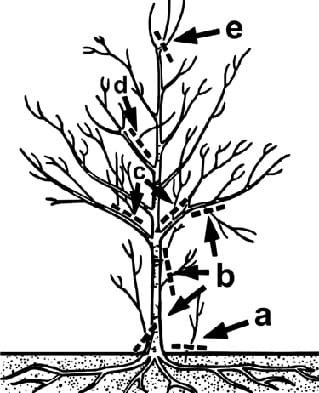
Remove branches that grow inward or threaten to rub against nearby branches (Figure 10).
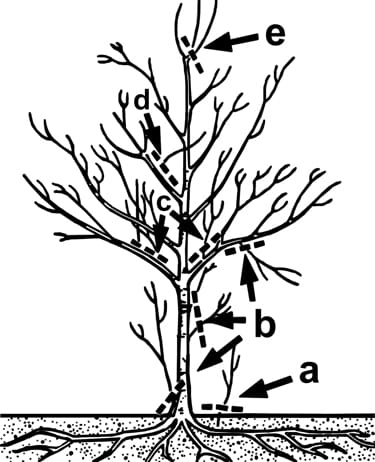
Figure 10. Remove suckers originating from below-ground roots (a), low-growing branches that interfere with maintenance (b), upright growing shoots or watersprouts (c), branches that grow inward or rub other branches (d), and branches that compete with the central leader for dominance (e).
Remove branches that grow downward from the main limbs which may interfere with mowing and other maintenance practices.
Prune branches damaged by insects, diseases, winter cold or storms below the damaged area. Prune branches of pear, pyracantha or loquat damaged by fireblight disease several inches below the infection. To prevent spreading the disease, sterilize pruning tools between cuts by dipping the blades in rubbing alcohol or a solution prepared from one part house-hold bleach to 10 parts water.
Trees such as Bradford pear, ornamental cherry, crabapple and ornamental plum form vigorous shoots (or suckers) at the base of the trunk and many upright succulent shoots (or watersprouts) along the main branches. These shoots starve the tree of valuable nutrients and detract from the tree’s overall appearance. Remove them while they are young.
Some trees develop upright shoots that compete with the main trunk for dominance. Remove these shoots if you want to maintain a conical or pyramidal growth habit.
Pruning evergreen trees
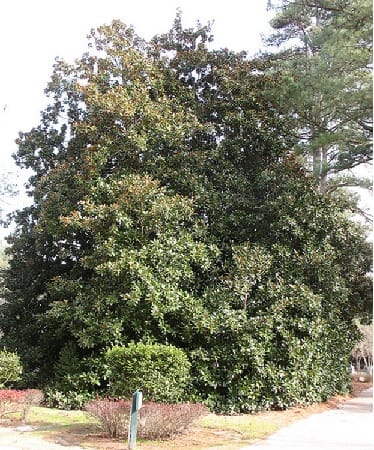
Broadleaf evergreens, like magnolias and hollies, usually require little or no pruning. In fact, most develop a naturally symmetric growth habit when left alone. Low-sweeping branches at ground level lend a natural southern charm to our landscapes.
You may want to prune some during the early life of the tree to balance the growth or to eliminate multiple trunks and/or multiple leader branches. Otherwise, routine annual pruning is not recommended.
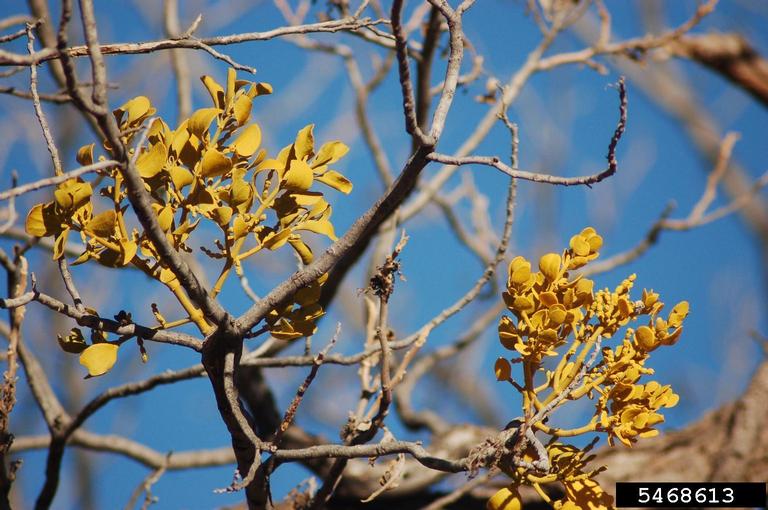
There are currently three mistletoe elimination interventions, each delivering varying results. The three interventions are pruning infected tree branches, shoot pruning of mistletoe, and/or using a labeled chemical spray (ethephon). Note any specific commercial product mentioned here does not represent an endorsement, nor a statement of efficaciousness, but a summary of marketplace information at the time this publication was prepared.
Tree Pruning – Infection site branch pruning is a common means of controlling mistletoe. A twig or branch infected with mistletoe can be pruned at the nearest healthy originating node below an infection site. Do not tip, top, or use internode cuts on a twig or branch. (See Figure 11 in original publication online). The target node for pruning should be at least 14 inches below an infection site. Mistletoe infection site elimination through branch pruning should be treated as a proper pruning (Figure 12) or reduction cut (Figure 13, Figure 14, Figure 15). Figures in the original publication show proper cuts to be made at the next lowest branch node greater than 14 inches below an infection. Years will be needed for a tree to regain structural integrity after extensive mistletoe removal pruning.
Mistletoe Shoot Removal – One traditional treatment for mistletoe infection is to knock off brittle mistletoe stems from tree branches. Mistletoe stems snap off easy and nearly flush with branch bark, usually at the remnants of the holdfast leaving the haustorial cushion behind still within a branch. This treatment immediately reduces water loss from a tree, and reduces mistletoe reproduction. Unfortunately, simply knocking off mistletoe stems does not eliminate infections because the endophytic part of the mistletoe remains intact. It usually takes 1-3 years before mistletoe shoots noticeably reappear after removal. Approximately 80% of all pruned mistletoe stems re-grow and while without green shoots, become completely parasitic on a tree. Periodic mistletoe shoot removal may be a viable treatment on main stem infections where pruning is not practical.
A few studies have used a combination of mistletoe shoot removal and blocking light to the haustorial cushion. Light has been excluded from haustoria by various wraps, sprays, and applications like heavy pruning paint applications, aluminum foil, tin disks, tarpaper, tape, caulking, or black plastic. It is critical to not injure tree tissues around an infection site with any topical coating or through affixing any covering. Mistletoe shoot pruning and light exclusion from an infection site was thought to prevent new mistletoe shoot formation and starve haustoria embedded in tree branches. Generally, these types of mistletoe shoot stub treatment have not been found to be completely effective and so, not recommended in most circumstances.
Chemical Spray – (Note that pesticide information was correct as of August 2008 – labeled uses can change. Check the pesticide label for the most recent information!) Ethephon [(2-chloroethyl) phosphonic acid] acts as a mistletoe shoot abscission and defoliator by generating ethylene, a plant growth regulator. For example in one study, a 2% ethephon treatment applied to mistletoe shoots in the dormant season defoliated shoots in 75 days with no resprouting for 225 days, and with no negative impacts on the host. This treatment did not significantly impact the haustoria and new sprouts from the haustorial cushion area formed within 1-2 years.
Currently there is a chemical product labeled for mistletoe shoot control which contains this shoot abscission chemical (ethephon). This product is sold under the name FLOREL brand growth regulator, a trademark of the Rhone-Poulenc AG Company, and distributed by Monterey Lawn & Garden Products, Fresno, CA. [EPA Registration Number 54705-8]. Information for this publication regarding this product came from the company’s web site (accessed 8/29/2008). All label information was derived from the electronic version of the chemical product label.
The product as currently formulated contains 3.9% ethephon (0.33 lbs ethephon per gallon). The chemical is a highly acidic, colorless, odorless, clear liquid. This labeled product “… will cause the abscission of … leafy mistletoe shoots in ornamental deciduous trees.” Technically, this product is not labeled for leafy mistletoe removal from evergreen trees. Note a wide variety of other concentrations and application methods have been used in past research papers.
This ethephon product should be sprayed directly on mistletoe clumps until foliage and stems are wet.
Timing is crucial to prevent tree damage. Spraying should be completed after Fall leaf drop and before tree bud burst in Spring when daytime temperatures are above 65oF. Mix the product following all label directions. For example, under current label mixing instructions, mix one quart of product in 2 gallons of water for 5400 ppm concentration. Use of a surfactant is recommended. Spray only when no rain is forecast for a minimum of 24 hours. Return to and re-spray large clumps of mistletoe in one week. Because only the mistletoe shoot is impacted, retreat every 3-4 years. Mix and spray this product immediately. Do not store the mixed spray liquid for more than a few hours. Care is needed to prevent over-spray from staining or etching hardscapes or damaging painted surfaces.
Remember to carefully read and review the product label for your personal safety, safety of other living things, and the legal context of product use. Do not use this product near individuals or habitats of protected species, some of which could be around the tree site or on the tree exterior.